







For every business owner, founder, and corporate executive, the driving question behind long-term operations is fundamental: How do we achieve consistent, profitable, and scalable business growth?
While the objective sounds straightforward—expanding market share, increasing revenue, and boosting organizational capacity—achieving sustainable growth is one of the most complex challenges a business can face. According to industry research, a massive percentage of early-stage startups and small businesses fail not because they lack a product or market demand, but because they attempt to scale prematurely or mismanage their expansion phases.
The core issues and questions surrounding business growth typically center on several recurring obstacles:
The Growth Bottleneck: As a company expands, the informal systems and hands-on management style that drove early success become major operational bottlenecks. Leaders find themselves trapped working in the business rather than on the business.
Cash Flow Management vs. Revenue Growth: Growing a business requires capital. Increased sales often demand larger inventory, higher headcount, and expanded infrastructure long before payment from those new sales is collected. This timing gap creates severe liquidity crises.
Market Saturation and Customer Churn: Scaling sales efforts without improving customer retention leads to a “leaky bucket” syndrome. Acquiring new customers becomes increasingly expensive, eroding profit margins if existing clients are constantly churning out.
Loss of Quality and Culture: Fast-paced expansion frequently strains product/service quality and dilutes team alignment, leading to operational friction and customer dissatisfaction.
The overarching problem is clear: business growth is not simply about doing “more” of what worked initially; it requires a structural evolution of how a company creates, delivers, and captures value.
2. Context & Background: Understanding the Mechanics of Business Growth
To construct a effective growth strategy, it is critical to understand what business growth actually encompasses and how different paths to expansion operate within market ecosystems.
At its core, business growth refers to the process where a company expands its operations, increases sales revenue, captures greater market share, or grows its bottom-line profitability. However, not all growth is created equal.
Organic vs. Inorganic Growth
Understanding the mechanism behind expansion is crucial for setting expectations and managing risk:
The Growth Equation and Key Metrics
From a financial perspective, long-term growth relies on balancing unit economics. A simple way to represent sustainable value expansion mathematically is evaluating the relationship between Customer Lifetime Value () and Customer Acquisition Cost ():
For a company to scale efficiently, this ratio should ideally be 3:1 or higher, meaning every dollar spent acquiring a customer generates at least three dollars in lifetime value. If expansion efforts occur when is low or negative, scaling will simply accelerate losses rather than generate sustainable profits.
Growth Matrices: Where to Find Opportunity
A classic framework for contextualizing growth paths is the Ansoff Matrix, which outlines four distinct growth vectors based on products and markets:
Market Penetration: Selling existing products to existing markets (e.g., increasing marketing spend or loyalty programs).
Market Development: Introducing existing products into new markets (e.g., global expansion or targeting a new demographic).
Product Development: Creating new products for existing markets (e.g., releasing an upgraded software tier or complementary accessory).
Diversification: Launching completely new products in entirely new markets (highest risk, highest potential return).
3. Solution & Advice: A Framework for Sustainable Business Growth
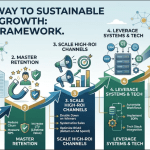
Achieving business growth requires shifting from reactive efforts to a structured, data-driven approach. The following strategy provides a blueprint for building a scalable foundation.
       [ 1. Optimize Core Operations & Cash Flow ]
                          │
                          ▼
        [ 2. Master Customer Retention & LTV ]
                          │
                          ▼
       [ 3. Identify & Scale High-ROI Channels ]
                          │
                          ▼
      [ 4. Leverage Systems, Tech & Automation ]
                          │
                          ▼
    [ 5. Build Leadership Depth & Team Alignment ]
Step 1: Secure Your Foundation and Cash Flow
Before pouring resources into customer acquisition, ensure your unit economics and operational cash flow can support higher volume.
Work Capital Management: Maintain a buffer of liquid capital to cover the cash-conversion cycle required during expansion.
Margin Health: Continuously review pricing structures and cost of goods sold (COGS) to protect gross margins as operational overhead grows.
Step 2: Fix the “Leaky Bucket” (Focus on Retention)
Retention is the engine of sustainable growth. Acquiring new customers can cost up to 5 to 25 times more than retaining existing ones.
Measure Customer Satisfaction: Implement regular feedback mechanisms such as Net Promoter Score (NPS) surveys to catch issues early.
Increase Lifetime Value: Introduce cross-selling, up-selling, or recurring subscription options to maximize revenue per user.
Step 3: Identify and Scale High-Performing Acquisition Channels
Avoid spreading marketing and sales efforts too thin across every platform.
The Rule of Concentration: Double down on 1 to 2 acquisition channels (e.g., organic SEO, outbound sales, paid search) where customer conversion and return on ad spend () are highest before diversifying.
Systematize Sales: Document repeatable sales processes so new account executives or team members can replicate successful results quickly.
Step 4: Automate and Delegate Operations
Manual workflows impede growth. Scale requires repeatable, automated systems.
Tech Stack Integration: Implement modern CRM, ERP, and project management tools to reduce administrative friction.
Standard Operating Procedures (SOPs): Document critical workflows step-by-step to enable seamless delegation and consistent quality control as headcount grows.
Step 5: Develop Leadership and Build Team Alignment
As an organization grows, top leadership must transition from tactical execution to strategic leadership.
Delegate Decision-Making: Empathetic, competent middle managers are essential to prevent executive burnout.
Align KPIs Across Teams: Clear Key Performance Indicators ensure all departments—from engineering to customer support—are working toward shared growth goals.
Strategic Reminder: Fast growth without solid operational infrastructure creates instability. True scaling means increasing revenue faster than your cost base.
4. Conclusion: Moving Forward with Strategic Intent
Business growth is not an accidental event; it is the natural result of disciplined execution, sound unit economics, and continuous operational evolution.
By identifying your core growth bottlenecks, selecting the appropriate growth vector, prioritizing retention over blind acquisition, and building robust systems, you transform growth from a chaotic challenge into a predictable, manageable trajectory. Focus on strengthening your operational core first—and sustainable, profitable expansion will naturally follow.