







In modern corporate language, few terms are tossed around as frequently—and misunderstood as thoroughly—as Business Development (BD). Business leaders, executives, and founders often struggle with a fundamental core question: What exactly is the scope of business development, and how does it drive measurable, long-term organizational value beyond immediate sales?
Because the title “Business Development Representative” (BDR) is frequently assigned to outbound sales reps or cold callers, companies regularly fall into operational traps that stunt their long-term growth. The primary issues businesses experience around business development include:
Short-Term Tactical Bias: Organizations often reduce business development to quick transactional sales, expecting immediate quarterly revenue rather than building strategic ecosystems, strategic alliances, and long-term pipeline value.
Role Confusion and Friction: When business development, sales, and marketing functions lack clear boundaries, teams duplicate efforts or pull in opposite directions. Sales focuses on closing immediate deals, marketing focuses on brand awareness and lead generation, while strategic partnerships fall through the cracks.
Misaligned Strategic Partnerships: Companies frequently pursue high-profile partnerships or joint ventures without assessing whether those relationships align with their core unit economics or long-term product roadmap. This leads to high effort, low yield agreements that waste resources.
Lack of Measurable Frameworks: Unlike sales (measured in revenue closed) or marketing (measured in traffic and leads), business development deals often involve long gestation periods, making them harder to evaluate without clear strategic metrics.
The underlying challenge is that organizations need a structured, strategic blueprint to define, execute, and measure true business development—transforming it from a ambiguous catch-all phrase into a revenue-multiplying growth engine.
2. Context & Background: Understanding the Strategic Purpose of Business Development
To execute business development effectively, organizations must understand how it fits within the broader commercial landscape.
At its core, business development is the creation of long-term value for an organization from customers, markets, and relationships. It bridges the gap between high-level corporate strategy and tactical execution, operating at the intersection of sales, marketing, product strategy, and strategic partnerships.
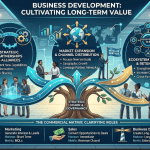
Clarifying the Commercial Matrix: BD vs. Sales vs. Marketing
While sales and marketing are critical execution functions, business development operates at a higher structural level to expand the boundaries of where sales and marketing can operate.
| Function | Primary Focus | Horizon | Key Metric |
| Marketing | Generating interest, brand positioning, and inbound lead flow. | Short to Medium Term | Qualified Leads (MQLs), CAC, Brand Reach |
| Sales | Converting qualified opportunities into paying customers. | Immediate / Short Term | Revenue Closed, Win Rate, Quotas |
| Business Development | Building strategic partnerships, entering new channels/markets, and unlocking growth ecosystems. | Long Term | Partnership Value, Strategic Market Share, Enterprise Value Created |
The Value Creation Mechanics of BD
From a strategic standpoint, business development operates on value creation levers that expand an organization’s overall market presence. Rather than selling a single unit of a product to a single customer, BD focuses on leveraging external relationships to reach thousands of customers simultaneously or build structural advantages.
1. Strategic Partnerships & Alliances
Co-marketing, co-selling, or integration agreements that combine the complementary strengths of two distinct organizations (e.g., integrating a payment gateway into a major e-commerce platform).
2. Market Expansion & Channel Distribution
Identifying unserved customer segments or geographic regions and establishing reseller, distribution, or licensing networks to access those markets rapidly without heavy capital expenditure.
3. Strategic Sourcing & Ecosystem Building
Securing critical supply chain access, proprietary technology integrations, or platform ecosystems that create high switching costs for competitors.
3. Solution & Advice: A Strategic Framework for Business Development
Building a successful business development engine requires a structured approach that moves from market evaluation to deal execution and relationship management.
       [ 1. Align BD Strategy with Corporate Goals ]
                           │
                           ▼
         [ 2. Identify & Target Strategic Assets ]
                           │
                           ▼
      [ 3. Construct Mutually Beneficial Value ]
                           │
                           ▼
      [ 4. Standardize Deal Execution & Governance ]
                           │
                           ▼
     [ 5. Manage Relationships & Measure Value ]
Step 1: Align Business Development Directives with Core Corporate Strategy
BD should never operate in a vacuum. Before reaching out to potential partners or entering new markets, establish strict alignment with the executive team:
Identify Strategic Gaps: Is the organization trying to accelerate market penetration, enter a new vertical, acquire specific capabilities, or increase customer retention?
Establish Target Criteria: Define non-negotiable parameters for prospective partners, including company size, technological compatibility, brand alignment, and market coverage.
Step 2: Conduct Systematic Partner and Market Mapping
Instead of reacting to inbound inquiries, take a proactive approach to ecosystem mapping:
Map the Ecosystem: Identify players across your value chain—complementary software providers, industry distributors, trade associations, and platform incumbents.
Prioritize Prospects: Evaluate potential partners based on market reach, brand reputation, execution capability, and strategic alignment. Focus resources on high-impact targets.
Step 3: Design High-Value Deal Structures
Successful business development deals depend on true win-win economics. Partnerships fail when one party attempts to capture all the value while shifting execution burden to the other.
Determine the Exchange of Value: Define clearly what each party gains—such as audience access, product capabilities, brand credibility, or cost reductions.
Align Economic Incentives: Structure revenue-share models, referral fees, or co-investment terms so that both teams are incentivized to invest real operational effort.
Step 4: Execute Structured Deals and Integration Plans
The signature on a partnership contract is the beginning of the work, not the end.
Draft Joint Execution Roadmaps: Outline clear timelines, resource commitments, technical integration milestones, and dedicated team leads for both organizations.
Establish Governance Frameworks: Schedule regular quarterly cadence reviews between partnership leaders to monitor joint initiatives, troubleshoot operational bottlenecks, and realign goals.
Step 5: Track Leading and Lagging Business Development Metrics
Evaluate BD performance using a blend of strategic and financial metrics:
Pipeline Metrics: Active partner discussions, prospective deal volume, and velocity of deals moving from contact to signed agreement.
Operational Metrics: Joint go-to-market events executed, partner-led integrations launched, and training sessions completed for partner sales teams.
Financial & Growth Metrics: Partner-attached revenue, indirect channel sales volume, reduced customer acquisition cost ($\text{CAC}$), and joint account retention rates.
Strategic Insight: A signed memorandum of understanding (MOU) without an execution plan is worthless. Focus heavily on operational rollouts to turn agreements into realized revenue.
4. Conclusion: Elevating Business Development to Drive Long-Term Enterprise Value
True business development is not about high-volume cold outreach or superficial networking—it is a strategic discipline focused on building sustainable pathways for long-term growth.
By clarifying the boundaries between sales, marketing, and BD, anchoring initiatives in core organizational strategy, structuring win-win partnerships, and maintaining rigorous post-deal governance, companies can build high-leverage growth engines. When executed with precision, business development unlocks exponential value, expands competitive moats, and positions an organization to lead its market for years to come.