








At its core, the foundational question driving every entrepreneur, executive, and team lead is simple: How do we build a sustainable, competitive edge that leads to long-term success?
Despite the simplicity of the goal, execution remains elusive. Organizations across every industry frequently struggle with a disconnect between high-level ambition and ground-level execution. The core problems businesses face around business strategy usually boil down to three major pitfalls:
Confusing Strategy with Planning: Many leaders mistake operational task lists, annual budgets, or goal-setting exercises (like setting revenue targets) for strategy. A list of ambitious goals without a deliberate path for outperforming competitors is merely a wish list.
Lack of Alignment and Clarity: Even when an executive team creates a solid strategic roadmap, it often fails to trickle down effectively. Frontline employees, middle managers, and functional teams end up working toward conflicting priorities, leading to wasted resources and lost momentum.
Inability to Adapt to Changing Markets: Markets evolve rapidly due to shifting consumer behaviors, technological disruption, and unexpected economic swings. Companies often fall into the trap of treating strategy as a rigid, static document rather than a dynamic, evolving framework.
The overarching issue is that businesses need a practical, actionable blueprint that bridging the gap between broad vision and everyday tactical decisions.
2. Context & Background: The Mechanics of Modern Strategy
To understand how to craft an effective business strategy, it helps to understand what strategy actually is—and how the landscape has evolved.
A business strategy is an integrated set of choices that uniquely positions a firm in its industry to create superior value for customers while capturing sustainable returns. It answers two fundamental questions:
Where will we play? (Target markets, customer segments, channels, and geographic regions)
How will we win? (The unique value proposition, competitive advantage, and capabilities that set the firm apart)
The Strategic Hierarchy
In modern organizations, strategy operates across three distinct levels:
| Strategy Level | Primary Focus | Key Responsibilities |
| Corporate Level | Portfolio & Allocation | Deciding which industries/markets to enter, managing resource distribution, and steering high-level growth (M&A, diversification). |
| Business Level | Market Position & Advantage | Defining how a specific business unit competes in its market against direct competitors (e.g., cost leadership vs. differentiation). |
| Functional Level | Operational Alignment | Aligning specific departments (Marketing, HR, R&D, Operations) to support the business-level strategic goals. |
The Value Creation Equation
From an economic perspective, business strategy revolves around creating value for stakeholders—a concept captured effectively by frameworks like the Value Stick. A business creates value by expanding the gap between a customer’s Willingness to Pay (WTP) and the firm’s Cost to produce the product or service.
To build a profitable business, strategic decisions must continuously work to either:
Increase WTP: Differentiate through superior quality, branding, innovation, or customer service.
Decrease Costs: Optimize operations, supply chains, and technology to deliver efficiency without compromising acceptable quality.
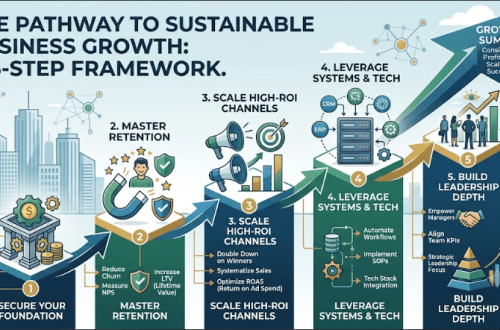
3. Solution & Actionable Advice: A 5-Step Framework for Strategic Success
Developing and executing a successful business strategy does not require a 100-page slide deck. Instead, it requires clarity, focus, and systematic execution. Below is a structured, step-by-step guide to building a winning strategy.
       [ 1. Define Vision & Core Values ]
                       │
                       ▼
         [ 2. Conduct Market & Internal Analysis ]
                       │
                       ▼
       [ 3. Choose Your Strategic Positioning ]
                       │
                       ▼
      [ 4. Build a Roadmapped Execution Plan ]
                       │
                       ▼
      [ 5. Measure Metrics & Iterate Continuously ]
Step 1: Clarify Vision, Mission, and Core Values
Start with your destination. A strategic plan needs a clear anchor.
Vision Statement: Paints a picture of what the company aspires to become in the long term (e.g., “To be the world’s most customer-centric platform”).
Mission Statement: Defines what the organization does today, who it serves, and how it delivers value.
Core Values: Sets non-negotiable behavioral boundaries for decision-making.
Step 2: Conduct Rigorous Market and Internal Analysis
Before making strategic choices, perform a grounded analysis of both your internal capabilities and external realities:
SWOT Analysis: Map out internal Strengths and Weaknesses alongside external Opportunities and Threats.
Competitive Analysis: Identify direct and indirect competitors. Analyze their pricing, market share, product features, and target demographics.
Customer Research: Gather real data on user pain points, preferences, and changing behaviors rather than relying on assumptions.
Step 3: Define Your Competitive Positioning
According to classic strategic theory, businesses must choose a primary generic strategy to achieve a competitive edge:
Cost Leadership: Positioning as the lowest-cost producer in the industry (e.g., Walmart, Ryanair). This requires high operational efficiency and economies of scale.
Differentiation: Offering unique features, superior branding, or exceptional service that allows you to charge a premium price (e.g., Apple, Nike).
Focus / Niche: Targeting a specific, narrow customer segment with tailored products or services that broader competitors overlook.
Key Rule: Avoid being “stuck in the middle.” Trying to be everything to everyone dilutes your value proposition and exhausts your capital.
Step 4: Translate Strategy into Tactical Roadmaps
A strategy is only as strong as its execution. Turn high-level objectives into actionable initiatives by setting SMART goals (Specific, Measurable, Achievable, Relevant, Time-bound) and cascading them throughout the organization.
Allocate human, financial, and technological resources exclusively to projects that align directly with your chosen competitive position.
Establish clear ownership across teams so every functional lead understands how their day-to-day work supports the broader strategic vision.
Step 5: Establish KPIs and Continuous Feedback Loops
To ensure your strategy stays on track, track a mix of leading and lagging Key Performance Indicators (KPIs):
Financial Metrics: Gross profit margins, Net Profit, and Return on Invested Capital (ROIC).
Customer & Growth Metrics: Customer Acquisition Cost (CAC), Lifetime Value (LTV), Net Promoter Score (NPS), and Retention Rate.
Operational Metrics: Team velocity, employee retention, and capacity utilization.
Hold quarterly strategy reviews to assess progress. Treat your strategy as a living framework: maintain conviction in your long-term vision, but remain flexible in your tactical approach when market conditions shift.
4. Conclusion: Moving from Strategy to Performance
A powerful business strategy is not about predicting the future with absolute certainty; it is about making intentional choices today to shape your position tomorrow.
By identifying your core challenges, understanding the broader market context, choosing a clear competitive position, and executing with discipline, you convert high-level ambition into measurable commercial success. Focus on clarity over complexity, align your team around shared goals, and stay agile enough to pivot when necessary. That is the essence of modern strategic management.