




1. The Key Question or Issue
What is the fundamental objective and modern challenge of the Sony PlayStation platform business?
For decades, the console gaming industry operated on a straightforward, hardware-centric paradigm: design a proprietary piece of hardware, sell it as a loss-leader or at thin margins, and recoup investments through licensing fees, physical software sales, and exclusive software titles. However, as production costs for triple-A (AAA) games balloon past hundreds of millions of dollars per title and consumer habits shift toward cross-platform play, cloud streaming, and mobile gaming, this traditional model faces a critical strategic pivot.
The primary issue facing Sony’s Game & Network Services (G&NS) division is: How can PlayStation maintain its dominant, high-margin platform business model while expanding its intellectual property (IP) onto external platforms—like PC, mobile, and transmedia—without eroding the core console ecosystem that drives player loyalty and recurring network revenue?
To solve this, Sony must continuously balance platform exclusivity—the traditional magnet for console sales—against the financial imperative of maximizing game reach, recurring digital engagement, and recurring subscription fees.
2. Context and Background
The Evolution of the PlayStation Business Model
To understand where the platform stands today, one must examine how the PlayStation business model evolved over five hardware generations:
+-------------------------------------------------------------------------+
|                       EVOLUTION OF PLAYSTATION                          |
+-------------------------------------------------------------------------+
| PS1 / PS2 Era           | Physical Disc Sales & Hardware Base           |
| PS3 / PS4 Era           | Digital Stores, PSN, & Subscription Services  |
| PS5 & Beyond            | Multiplatform IP, Live-Service & Ecosystem    |
+-------------------------------------------------------------------------+
The Classic Hardware & Licensing Era (PS1 & PS2): Sony’s initial success was built on mass-market hardware adoption, proprietary media formats (CD-ROMs and DVDs), and lucrative 30% platform cuts (the “platform tax”) on third-party software releases. Exclusive titles were leveraged primarily to move plastic console units.
The Digital Network & Subscription Shift (PS3 & PS4): With the establishment of the PlayStation Network (PSN) and PlayStation Plus, Sony shifted toward digital distribution. Hardware sales became a gateway to continuous service revenues, including multiplayer access fees, digital game downloads, in-game microtransactions, and subscription tiers.
The High-Cost, Cross-Platform Horizon (PS5 Era): Today, with over 125 million monthly active users on PSN, the PlayStation 5 has generated record revenues and profits. Yet, the cost of top-tier first-party game development has risen drastically. A single blockbuster can take 5–7 years and upwards of $200M–$300M to produce. Relying solely on console unit sales to amortize these costs creates significant financial risk.
+-------------------------------------------------------------------------+
|                  CORE ENGINES OF PLAYSTATION REVENUE                   |
+-------------------------------------------------------------------------+
| Digital Software Sales  | 30% cut on third-party store transactions     |
| PlayStation Plus        | Tiered subscriptions (Essential/Extra/Premium) |
| Hardware & Accessories  | PS5 consoles, DualSense, PS Portal              |
| First-Party Franchises  | Direct software sales & transmedia expansion    |
+-------------------------------------------------------------------------+
Key Market Pressures Shaping Strategy
Rising Platform Costs: Hardware components and advanced silicon remain expensive to manufacture, limiting how rapidly console prices can drop over time.
Changing Consumer Expectations: Gamers increasingly expect cross-play and cross-progression, making platform “walled gardens” harder to maintain rigidly.
Transmedia Synergies: Successful film and television adaptations (such as The Last of Us and Uncharted) demonstrate that PlayStation IPs have mass appeal far beyond traditional console owners.
3. Strategic Solution and Advice for the PlayStation Platform
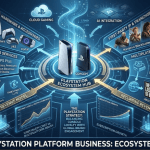
To solve the dual challenge of high production costs and platform retention, Sony’s strategic execution relies on a multi-pronged ecosystem framework. Rather than viewing PlayStation merely as a physical console box under the television, Sony is re-architecting PlayStation as an integrated digital entertainment ecosystem.
                       +-------------------------+
                       |   PlayStation Core IP   |
                       +------------+------------+
                                    |
        +---------------------------+---------------------------+
        |                           |                           |
        v                           v                           v
+---------------+           +---------------+           +---------------+
|  PS5 Console  |           |   PC & Cloud  |           |  Transmedia   |
| (Core Platform|           | (Expanded Reach|           | (TV, Film &   |
|   & Services) |           |  & Engagement)|           | Merchandising)|
+---------------+           +---------------+           +---------------+
1. Optimize First-Party Windows and Platform Exclusivity
Keep Core Single-Player Titles Day-One Exclusive: High-profile single-player narrative experiences (e.g., flagship narrative adventures) should remain exclusive to PlayStation hardware at launch. This protects the core value proposition of owning a PS5/PS6 console.
Tactical PC Ports: Releasing narrative single-player titles on PC 18 to 24 months after console launch captures secondary sales, monetizes long-tail catalog value, and serves as top-of-funnel marketing for future hardware releases.
Simultaneous Multiplatform for Live-Service Games: Live-service and multiplayer titles require immediate scale and cross-play to thrive. Releasing these games simultaneously on console and PC maximizes day-one active player pools and ongoing microtransaction revenue.
2. Maximize Average Revenue Per User (ARPU) via PS Plus Tiers
Instead of pursuing unsustainable subscriber volume at discounted rates, Sony’s focus must remain on upselling existing active users to higher-tier services (PS Plus Extra and PS Plus Premium).
Expand high-value perks such as cloud streaming, game trials, and a curated catalog of legacy and third-party titles.
Maintain a stable, predictable recurring revenue base that buffers against the cyclical, hit-driven nature of standalone software releases.
3. Track Engagement Metrics Over Hardware Units
Modern platform performance should be judged primarily by Franchise Engagement Hours and Monthly Active Users (MAU) rather than raw hardware shipments alone. Maintaining 120M+ active PSN accounts creates a resilient marketplace for digital software, add-on content, and third-party platform cuts.
4. Leverage AI and Transmedia to Fuel Brand Ecosystems
Generative AI Tools: Implement AI technologies into internal development pipelines to streamline asset creation, lowering game development lead times and budgets without replacing human creative vision.
Transmedia Integration: Coordinate game releases alongside TV, film, and merchandise adaptations to create cross-promotional flywheels that bring non-gamers into the PlayStation platform fold.
4. Conclusion
The Sony PlayStation platform business has evolved from a traditional console hardware operation into a sophisticated, multi-channel entertainment ecosystem. By leveraging the strength of its PlayStation Network, refining its subscription tiers, and selectively opening its IP to PC and transmedia markets, Sony successfully mitigates the financial risks of modern AAA game development.
The long-term resilience of PlayStation depends on maintaining this strategic equilibrium: keeping the home console as the premier, best-in-class gaming experience while allowing its powerful franchises and digital services to reach players across every screen.
For an official corporate overview of Sony’s strategic direction and financial outlook for the platform, watch the Sony Corporate Strategy 2026 Presentation. This video provides direct insights from top executives regarding PlayStation’s network growth, AI integration, and long-term business goals.